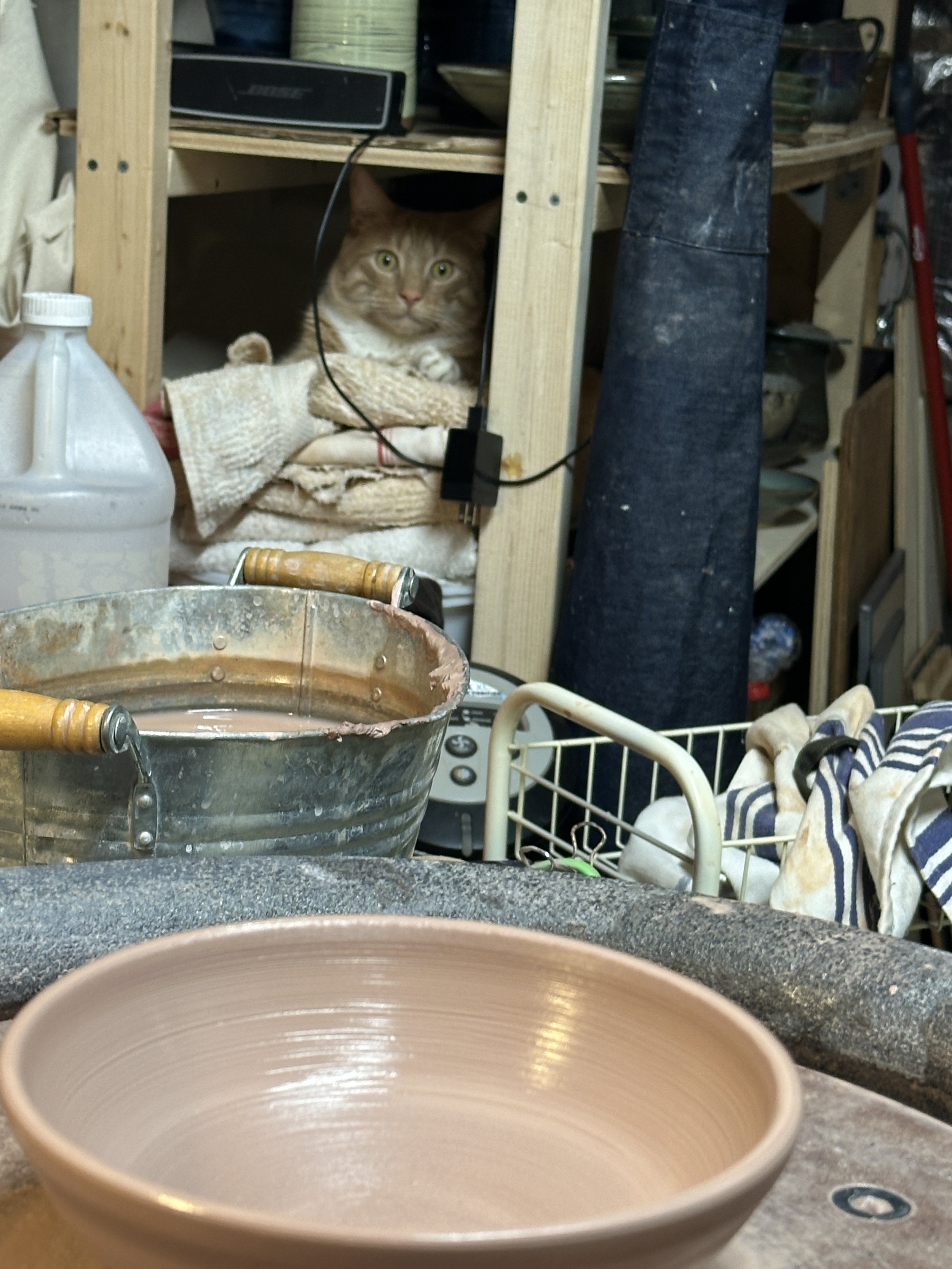
The process of pottery making
I first start with wet clay. All my work is currently using Stoneware clay. I use a variety of clay bodies from smooth white, grays, light and dark browns to red and black clay. The textures are smooth to sandy clay, clay with added Iron and manganese to add tooth and effects to the glaze
Here’s Neo hanging out with a fresh bag of clay ready to be worked

I first wedge the raw clay to wake it up a bit and to make sure all of the air bubbles are worked out of it

The clay is then centered on the wheel and worked until the desired form is created


Trimming - Is next after the piece has dried a bit to what is known as the “leather hard” stage. I prefer to trim as little as possible. This process allows me to define shape and style in my hands at the beginning stages rather than relying on the use of a trimming tool. I feel it is a bit more of an organic process and more demanding to work with the structure of the design, especially larger forms. At this stage of leather hard, if making mugs, pouring bowls or anything with handles or adornments, are applied, using scoring techniques, vinegar and a bit of finesse.

First Firing - Bisque. After a few days of drying, I slow fire the greenware and use a hold at 185 degrees of 2 to 6 hours just to make sure my ware is fully dry. This keeps it from going to the boiling point which would explode the pots. The top temperature reached is around 1945F degrees.
In the bisque firing it is safe to stack the pieces on top of each other and to have them touch.


After the kiln has run and cooled for about 48 hours, to aprox.150F degrees, the kiln can be unloaded. At this point, the items are stacked on a shelf and cleaned with a sponge and fresh water to get off any remanence such as dust or loose clay particles that may affect the glaze application.


Glazing - The next stage is most every potters love/hate relationship with the process! We love it because this is where the final touches of the feeling, vibe connection finalizes the relationship between form and visual contrast. The challenging part is that it comes at a significant time cost with the glaze application process. At least for me, I get bored with the same colors used over and over again, it could be because I am not as tenured as a lot of successful potters where they can take simplicity of color and change a few accents and achieve masterful results with small nuances in application.

With glaze combinations tracked and recorded, the items are finally ready for the final firing


The Kiln Fairies are working their magic at aprox. 2232° F


Completed pieces


